The Luminaries, by Eleanor Catton: astrological archetypes through literature

I thoroughly enjoyed this 800 odd page novel, set in gold-rush New Zealand. The astrological symbolisim is obvious from the outset with star charts drawn up to represent the planets at the time. It doesn’t include Uranus, which was discovered some seventy years earlier, just the old astrological planets. Incidentally, Neptune was being discovered around the same time the novel is set (1865). I just found out that Eleanor Catton read the collected works of Jung before she embarked on the novel and had the idea that 12 characters would represent the zodiac while others would represent the planets. It’s very clever but doesn’t cut in on the story which is wonderfully well written, so much so that it has been shortlisted for the Booker.

I do believe Catton used the movements of the planets to guide the plot and decide the scenes she was writing.  It would take much re-reading to figure out all the intentional synchronicity.  She takes great care to describe each character, slipping in the properties of the astrological archetype in a way which could easily go unnoticed. Of course every zodiac sign and planet has many different facets and Catton seems to draw on a few of these for each character and also incorporates other characteristics which might better fit the story.  I won’t go too much into what is obviously stated, I will focus instead on broader reflections of the novel’s symbolism.

This story begins in the 12th house of the psyche, whereupon Walter Moody (Mercury) unwittingly interrupts a secret meeting of 12 very different men at the crown hotel. It must be in the 12th because we are so in the dark, and where else would we find 12 men, symbolising the twelve zodiac signs, than in the natural home of Pisces? In fact, this whole story belongs to the 12th house as the character symbolising the sun and psyche, Emery Stains (fantastic name) is literally stumbling around in the dark for the almost the entire journey.  Therefore, treating this novel as a Jungian journey means delving into the exploration of one’s psyche in the dark, with minimal illumination that grows as we progress.

Despite not being represented, the archetype of Neptune is obviously in the room, probably sitting in the back corner smoking opium. Opium is very prominent in this story both in the pipe and in laudanum tinctures.  There are many delusions at play, of grandeur, of love, of mysteries and plots that might actually not exist. This story also has a very strong Pluto/Scorpio theme, secrets, suspicion and paranoia add tension to the narrative. There is gold involved as well as prostitution and death. You can’t get more 8th house than that.

I would indeed like to re-read this novel and observe the characters in relation to my own personal archetypes in the style of Clarissa Pinkola Estes. It promises to be an interesting and illuminating journey into the dark recesses of the subconscious.

The predator archetype in the social ecosystem

I drove past a police car today. As usual, despite not doing anything obviously illegal, the sight of the white, yellow and blue elicited a moment of physical anxiety. I can almost feel my glands releasing the hormones that would naturally assist in protecting from predators. Even the police cars themselves are designed to look like predators. I have written about the predator archetype before and discussed it in relation to the fallen magician, but this time I want to focus less esoterically and more sociologically on this powerful symbol.

Seeing the police car, and my physical reaction to it, made me think of the role of the predator in an ecosystem. In her magnificent novel, Prodigal Summer, biologist and author Barbara Kingsolver describes the importance of predators in an ecosystem. Take all the starfish out of a rock pool and the diversity of life drops to zero. The food the starfish would normally eat multiplies out of control until it has nothing to sustain it.

The predator has a regulatory role, and it’s important. The police force fulfill this role, along with the judiciary and other systems for keeping order. Sometimes they cross the line and act out the shadow side of the archetype: corruption, exploitation, excessive violence, sexual assault.  Sociologists like to point out that the police force are a gang and function in much the same way, despite being a legitimate gang. Illegal gangs also fill predatory roles in a society, some socially beneficial, some detrimental.

In astrology, Saturn is the regulator, the structurer and restructurer, the disciplinary force. Saturn, like the predator archetype in its positive polarity, has the job of letting die that which must die in order that the healthy psyche may live.  It both the force which keeps us safe and that which poses the most grave danger if we step out of line.  When suppressed, this force is at its most dangerous. Dis-empowerment makes it desperate and ruthless, just as on a social level the most disempowered populations are the most likely to form gangs.

Healing this social and personal pathos involves bringing it into the light of awareness, stripping back the suppression, healing and empowering healthy functions of regulation.

Meditations on Virgo: complexities of the virgin/whore/analyst archetype

Everyone has a little bit of Virgo, and what better time to contemplate this extraordinarily complex archetype than a Virgo new moon? Some people call Virgo a duel sign, but she is a lot more complex than that; how else could she govern health, sickness, work, cleanliness, criticism and submission? Virgo is one of those signs that can seem boring on the surface, but when you dig a little deeper you might be surprised. Virgo wants to heal you, she wants to analyse you and she wants you to get off your ass and do some work – properly! She also wants to roll around in the dirt and explore the dark recesses of the psyche with a magnifying glass.

As an earth sign, Virgo is grounded, although she does have neurotic tendencies. Like Gemini she is governed by Mercury, the messenger/communicator, although she’s not as childlike, fast or flighty.  She excels at communication as long as she doesn’t get too anxious about it. She loves freshly mown grass and spring blossoms. Her colours are teal and white, greens and browns. She belongs in the sixth house of hard work and, traditionally, slavery.

Virgo is strong.  She cannot be slut-shamed. She is beyond that. She submits on her own terms. She owns her darkness.  The mistress of contradictions, she is the secretary and the cleaner; the innocent maiden and the auditor; the therapist and the patient; the hypochondriac and the doctor; the workaholic and the servant. No astrological archetype better represents the contradictory virgin/whore.  It is her obsessive cleanliness that makes dirt so appealing and, like all control freaks, Virgo is sexually submissive. Holding on so tightly means she has a deep need to let go.  She is tight with money but appreciates quality purchases.  After a while the contradictions begins to make sense: one’s inner prostitute is the guardian of one’s integrity, after all.  It is her job to let you know when you are in danger of trading your self-worth and selling yourself short.

To find out more about your Virgo look at where it sits in your natal chart. Every house represents a different part of your life. Does Virgo govern a house or is it intercepted, (stuck in between two houses) leaving your highly-strung analyst deep inside your psyche, screaming to get out? If you have planets in Virgo, think about how the archetypes of the planets click or clash with the contradictory Virgo vibe.

Yes, Virgo can be anal-retentive with a stationary fetish and a penchant for delicate floral print fabric, especially if you have a natal Venus in Virgo. Venusian Virgo is very particular about what she likes: a total aesthete guru. She loves lists and ticking things off gives her little jolts of pleasure, she also has a habit of analysing her partners half to death, trying to fix them.  She abhors clutter and unhinged garishness. Planets in your 6th house may interfere with Virgo’s master plan to analyse and categorise everything.  Uranus, the chaos magi will electrify her chi all over the place making a stable work-life an unlikely possibility.

A new moon in Virgo is a good time to set fresh intentions and let go of old emotional baggage, especially around your mum.  The maternal moon is often symbolic of the emotional self and the mother (also the nurturing father, or lack there of). Mothering is damn hard and no one does it perfectly.  Every time your parents failed to nurture you, your inner Virgo was probably keeping score, holding on to each painful experience for later analysis. Maybe it’s time to let go of that crap. You don’t need to over-think it, just intend it. You can go one step further and write your mom a letter. Mine goes like this:

Dear Mum. I have been decluttering my life on all different levels, as I explained before, courtesy of the Virgo new moon.  As the moon represents the mother, emotions and nurturing I decided that this is a good time to let go of any emotional baggage and resentments I may be holding onto from my childhood, consciously or subconsciously. I now understand how hard it is to be a parent and how easy it is to fly off the handle. I release you from all old emotional debts and all childhood needs left unmet. Love xoxo

Decluttering by the moon: Virgo dark moon phase

Decluttering by the moon: Virgo dark moon phase

image

In the Southern hemisphere it’s time for spring cleaning and in the Northern the trees are beginning to let go their leaves. It’s time to shed excess baggage and the last few days of the Virgo dark moon have been especially good for this kind of work. I imagine if I hadn’t been on a 24 hour decluttering spree I would have felt extra frustrated with everything else.

Bearing in mind that the outside reflects the inside and vice versa, cleaning the house is a great way to clear the mind. Tidying one’s bedroom is akin to tidying the innermost room of one’s psyche, and cleaning can be so satisfying. I wish I was taught this as a kid, rather than learning to resent dumb chores that took up valuable TV watching time.

A few months ago I began noticing the Virgo moon coinciding with my cleaning habits. One full moon I cleared out the worst corner of the kitchen. When I checked my emails on Monday I read in the Daily Mystic that the full Virgo moon was perfect for a spree.

I now have exceptionally minimalist bedside surfaces (by my standards). My habit of keeping things in beautiful bowls had gotten out of hand, so I spent hours sorting through batteries, hair fascinators and other debris. After much deliberation two large bowls of collected crystals have been replaced with a small dish of favourite gems. And after two drop offs to the local recycling centre I have two bags of treasures to give away and a tidy costume collection. It’s hard to let go of shiny things, especially those collected over a long time, but much better than turning into the miser from the Osho Zen Tarot.

image

The dark moon phase, just before the new moon is the best time for self-care, introspection, letting go and not getting into trouble. This is the waning, resting, releasing and rejuvenating part of the month before the fresh start of the new moon.

Everyone I know seems to be on a detox at the moment and given the heath obsessed anal-retentive nature of Virgo, its probably a good time for juice fasts and colonic irrigation, especially if you’re going through a major Saturn transit. Counselling and other brain-clearing activities also wouldn’t go amiss along with cleaning up your work environment, or even just your attitude to work and health. After cleansing and clearing on all different levels I’m ready for the fresh start of the new moon. Time to set powerful new intentions.

Deconstructing the Psyche: the animus in the wall


A wise woman once told me that the psyche is a lot like a wall: if the bricks aren’t laid properly at the foundation, it doesn’t matter how many bricks you build up, the wall will always be wonky. Now, I have a great appreciation for wonky things, but when it comes to my psyche I would prefer it to be strong and resilient.  Most of all, I would love to be free of the feeling that there’s something wrong or broken that needs to be fixed. Apparently it’s possible – all you have to to is deconstruct the wall, brick by brick, fix the problem at the foundation and then you can build yourself a strong, stable wall.

The wonky bricks might come from a number of things: childhood trauma, neglect or needs not being met.  I have been slowly processing my traumas as they emerge, and I am getting good at recognizing them when they’re projected on to other people close to me. I can tell because when trauma is triggered I get intensely emotional – angry, sad, scared – in a way that outweighs reason.  The more awareness I build, the more I can move on. But it’s not only trauma wonky-ing my wall, there are a few bricks missing.

One of the main things I have (recently) realised about my childhood is the absence of good male role-models. People often worry about the lack of male role-models for boys, but rarely do they consider them for girls.  How are we to draw a healthy animus (male part of the self), with no artists model? I grew up with a tyrant of a step-father, a dad who lived far away, no close uncles and a distant (but kind) grandfather. It’s really no wonder that as an adult I have had so many bizarre, and not-very-healthy relationships with men. So, bearing this in mind I have been embarking on a journey to re-construct a healthy animus. Externally, I have built good friendships with psychologically balanced and self-aware men.  Internally I have worked with archetypes – the father, the hero/rescuer, the lover.  I have even started to see this work reflected in the outside world – for example, I have actually started getting appropriate crushes on healthy and well-rounded men for a change.

I don’t know much about this, really, but apparently Jung talked about different stages of development for the animus archetype. The first is very physical, progressing through to psychological and spiritual awareness. At the moment, my animus is still in a petri dish, but it’s growing – and it’s healthy – and it’s a breath of fresh air.


Inner Tyrant: the evil stepmother archetype

“Wicked Stepmother” by Christy Norris

She appears in numerous fairy tales: cruel and ruthless, miserly yet unfairly generous to her own ugly daughters. She feeds the greedy, self-pitying elements of the psyche and starves, neglects and abuses the innocent children: Hansel and Gretel, the good and beautiful Cinderella, Vasilisa, Snow White.  She is a terrible parent to the psyche: insecure, desperate, plagued with fears and loathing; she is murderous.

She is the cousin of the wicked witch, the sister of the predator. Like them she is a shadow archetype, but unlike them she resides in the house of the personality while they attack from the outside.  She is the inner voice of negative self-talk, the self-criticism, self-deprecation. She seeks to control the good and innocent elements of personality because she is afraid. Of course, not all stepmothers are evil, and birth mothers and fathers can be just as tyrannical but the symbolism of the stepmother archetype is one of severance and separation: she represents a fracturing of the psyche that is difficult to re-integrate.

Just as in the personality these shadow elements come from fractures and suppression, in society the repression of femininity has led to the demonisation of strong women. Strong women are often discriminated against.  Female politicians, prominent feminists, and leaders are judged on their appearance and personality, their very femininity is called into question time and time again. They are shaped into the evil step-mother or the witch, representing, in the outside world, this part of the psyche that is so difficult to manage. She is the product of misogyny.

In Cinderella and Snow White she is defeated, with the help of dwarves or the fairy god mother, but ultimately by the prince.  From a feminist perspective, this story is achingly patriarchal, complete with the happily-ever-after ending. A woman cannot save herself, she must play the role of the helpless victim and await her rescuer.  From a symbolic perspective the prince represents the animus of a woman’s psyche, although this strong defensive archetype need not be a masculine.

In the story of Vasilisa the Wise, as told by Dr. Clarissa Pinkola Estés, the young heroine defeats her cruel step-family with the help of the little doll her dying mother had given her, symbolising intuition.  The stepmother’s plot to kill the sweet and uncomplaining Vasilisa was to send her into the forest in search of fire from Baba Yaga, the terrifying witch-crone. With the help of the intuitive doll Vasilisa is able to complete impossible chores and return home with a fiery skull on a stick. This burning gift of awareness watches the stepmother and step sisters all night and by the morning they are burnt to cinders.

The evil stepmother archetype and the process of burning up one’s inner tyrant through awareness and observance is reminiscent of Eckhart Tolle’s ‘pain-body’ and his advice on dealing with it.  The pain-body concept is the tangle of emotional damage everyone carries around with them. Sometimes it is dormant and sometimes it is active. It seeks to feed itself through creating drama and misery. Tolle advises close observance of the pain-body, and the cultivation of self-awareness, in order to overcome it’s controlling influences.

Astrologically, as the pathological parent, she resides in the fourth and tenth houses, in Cancer and Capricorn, in the afflicted Moon and Saturn.  She is cunning and resentful as the dark side of Scorpio, Pluto and the eighth house can be and she and her daughters’ gluttony could be represented by an unruly Taurus, Venus and the possessive second house.

The Predator Archetype (part two)

In my previous post about the predator archetype I didn’t go into the back-story of this universal archetype.  Of course such a dark character must have a story. According to Estes he is a fallen magician. A personification of the psychopathic wounded ego trying to be more than one is. Icarus flew too close to the sun and suffered the consequences and the this damaged part of the psyche over-extended in a similar way and exists in a state of permanent over-compensation.

On a personal level, the predator is a fragment of the shadow: the part of ourselves seeks redemption in all the wrong places. It has lost its own light and plots to steal the light of the psyche. It is our internal psychic vampire, pilfering our creative potential, holding us back with fear. This archetype offers a warning against the reckless pursuit of power.

On a wider social level, this archetype makes easy prey of women who have been trained since infancy to ‘be nice’, it seeps out of advertising. In the West it is disguised as the freedom to choose to be exploited, in more conservative cultures it is the invisible dominating force that women hide from.

Some people seem to unwittingly personify this fallen magician archetype all too well. I have met a few people who have tried to pursue the occult for power, either favoring hierarchical traditions or claiming to be far too unique, too special, too powerful to follow others. There was always something odorous about these people, something of the rodent in their appearance, a dangerous kind of cunning.

The Skeleton Woman: the Victim, the Rescuer and Archetype Alchemy

Warning: this post starts out all serious-like and gets more quirky later on.

Image

Over the past few months I have been very slowly reading, re-reading and digesting Women Who Run With the Wolves by Clarissa Pinkola  Estés. I think if I had picked this book up earlier in my life it would have gone over my head or I would have gotten frustrated with it but this is just the right time. For me the Jungian archetypes combined with mythology weave a transformative spell powerful enough to shift old patterns and resolve deep traumas. The following is my re-interpretation of one of the stories  Estés tells.

This is the story of the skeleton woman, an Inuit legend:

 A long time ago she was thrown from a cliff by her father.  No one remembers exactly why, but she was plunged into the ocean and there she remained, tangled in seaweed, her hair floating, her flesh being eaten away by the creatures of the sea.  One day a fisherman, unaware that the area was said to be haunted, came along in his little boat.  His hook caught hold in her diaphragm.  Thinking that he had hooked a really big one he began to tug.  The ocean rippled and seethed and, after a long struggle, the skeleton woman was freed.  The fisherman did not see her terrifying skeletal form rise up from the water, he had turned away to fetch his net, but the shock when he turned back around! He began to paddle frantically away, unaware that she was tangled in his line, and all the way home she followed him, right into his snow house. It wasn’t until he lit his oil lamp that he saw her, and while still terrified, something softened in him; perhaps it was the lamp light, perhaps his own loneliness.  He began to untangle her and as he did he sang a lulling song. She didn’t dare move.  When the work was done he covered her in furs and, exhausted, went straight to bed. In his sleep he cried a solitary tear of loneliness and the skeleton woman was overcome with the thirst of it.  She drank of the tear, of the oceans of loneliness, and quenched her thirst, then she reached into the fisherman’s rib-cage and took out his heart.  She drummed the heart and drummed flesh back over her bones, creating herself anew, then she slipped into bed beside him.  In the morning they went away; some say they went back to the ocean and were fed by the creatures of the sea that the skeleton woman had known.


This is a story of transformation (Pluto/Scoprio), of relationship (Libra/Venus) and of healing (Chiron/Virgo).  This is the story of the victim, flung from the cliffs by her father, and the unwitting rescuer.  The victim is an archetype I have been working with a lot lately.  It is hard to think of myself as a victim because I don’t want to be weak, but I’m trying to process childhood trauma and what else can a traumatised child be but a victim? According to Carolyn Myss everyone has four key archetypes: The child, the victim, the prostitute and the saboteur and each is a guardian of something.  The child is the guardian of innocence while the victim is the guardian of healthy boundaries.  This story explores and re-negotiates boundaries between two aspects of the self allowing for healthier boundaries with the outside world.  I also have quite a strong rescuer complex, so I can relate to this story both externally in terms of relationship, as the author does, and internally with my own rescuer animus.

I have become so aware of the skeleton woman at the bottom of the cliff; the innocent, yet terrifying, wounded, victimised part of my psyche.  I am less aware of the fisherman.  I don’t have much idea of what a healthy animus looks like having few male role-models in my life.  My father was someone I was once a year in my childhood and my step-father might as well have thrown me off a cliff psychologically.  So I was thinking about the key attributes a healthy male-part-of-my-psyche might have: strength, compassion, health and presence (as in: actually there).  I also think he might look like Johnny Depp. Just saying.

So I went through a deep meditative exercise; on one level I looked at the things going on in my life externally at the moment (which are private – don’t be nosy), on a second level I imagined the plain old victim and rescuer archetypes sitting down at a table in the house of my psyche and on a third level, I played out the skeleton woman story with Johnny Depp cast as the fisherman.  I think it would make a great screen-play.

I could feel my inner skeleton woman, lurking in the depths, corroded by fear (or fish?), alone, abandoned  afraid and utterly terrifying.  I watched see the rather attractive fisherman approach, he thinks he’s hooked a big one – just as most people do right at the start of a relationship with their elaborate infatuative fantasies.  The tussle that proceeds is largely carried out unconsciously – under the water – and it isn’t until the struggle is over that Depp realises he has bitten off more than he can chew.  His excitement about the fish was just the tip of the iceberg of ‘Ahhhh!’ and he runs screaming.

Meanwhile the rescuer archetype (also Depp like) has swaggered in towards the table and is facing the victim, his other half.  The victim looks sullen  she is young, her eyes are sunken and downcast: hopeless, helpless, pathetic. They don’t know what they’re getting themselves into but there is a sickening anticipation – excitement and fear.  They are each other’s compliment, opposite, other-half.  They are like yin and yang and out of balance it’s just a weird grey mess.  I don’t know why the rescuer archetype is so frightened of her.  Maybe it’s the responsibility of the life-saver over the saved life, maybe he’s just afraid of commitment, maybe it’s that weird fishy smell.  The victim archetype is terrifying because she is terrified, because fear has eaten away all the nice juicy fleshy parts of her and all that is left is the skeleton in her closet, the hidden terror of not being good enough or of being bad.

Somewhere along the line both Depps see something worth saving and the untangling process begins.  For the archetypes at the table, this is a process of working out fear and the beginnings of the mingling of the two opposites. As Estés states, every step of the process is important – you cant’s skip the untangling and jump straight into bed with your handsome rescuer – that is fantasy – it’s not sensible at all.  Untangling isn’t just foreplay either, it’s painful it’s facing up to the past and becoming more self aware and it’s being exposed to someone else – that is what intimacy will do to you.  Untangling is being vulnerable and still and allowing the rescuer archetype to do his work – the story in relationships is usually different, there is usually much more re-tangling and holding onto the line, there is a fear of being exposed and being vulnerable and holds the process back.  Untangling, like childbirth, is a surrendering process.  After the work is done and the baby is born, she is wrapped, as the skeleton woman is wrapped in furs.  It is time for rest.  That is how you can tell your own untangling is done, the victim is quiet.  She stops sobbing at the table and pleading, she is still and calm, her anguish is gone but she is thirsty.

The drinking of the tear is the first active thing the skeleton woman does (in my version of the story, anyway).   She is helping herself, finally.  The victim is no-longer pathetic and helpless. She is asking for what she needs or taking it when she finds it.  She is quenched, emotionally by the loneliness of her rescuer – she has found the black spot in his white half of the ying-yang.  She has found herself in him, just as he saw something worth saving in the lamp-light.  This gives her the strength to take his heart and heal herself – for we all must save ourselves in the end – even the victim.  She is now an active agent, re-building her body, letting go of her fear.  The victim at the table has grown, she is glowing, she is aware of her past but no-longer trapped in it.  The movement, the drumming the dance of this is important.  Movement and healing are always related.  She dances herself into beauty, into confidence.  She has taken back what her father stripped from her.  Then it’s time for bed.

The mingling of the two archetypes is also a dance – a partner dance.  It is the ying and yang fish swimming together around and around, it is the coming together of the two disparate fragments of the same whole, the completion of the journey of healing and the creation of new freedom.  The two archetypes can now leave hand-in-hand and return to the waters of the subconscious where they are fed by the same fish that used to eat away at the skeleton woman and evade the fisherman.

Anatomy of the Shadow

It’s the trick of the mind that makes you think there’s someone hiding in the darkness, the monster under your bed, the stranger’s footsteps echoing too close behind in the street at night…

Collectively it’s the enemy, the criminals we want to lock up, the rapists, sadists, murderers. It’s the incest inflictors, child abductors, perpetrators, pedophiles, predators. It’s the tragedies, the atrocities of war, the suicide-bombers, fanatics and shopping-mall shooters. It’s the foreigners, the Other, the people who look different: strange eyes, unusual skin colour, funny accents.  The shadow might be feminism, if you’re threatened by the idea of strong women or of equality. It might be gay people, they might disgust you if you’re afraid of your own queerness, of the queerness of being human.  It might be right-wing politics or bible-bashing gay-hating church groups. It might be drugs if you’re too scared to understand them.  The shadow is in fairy tales: the bad guy, super-villains  the evil step-mother, the dark sorcerer. In Disney he often has darker skin, she is ugly and wears dark clothes, he has a foreign accent. The shadow is always powerful and yet somehow defeated by sheer naive innocence, by love, by faith. If only it were that simple.

The shadow is always on the news, sometimes as a person, a religion, a regime, sometimes as a tornado, an earthquake, a hurricane, a cyclone, a volcano, a flood. It unites us in our shared enemy, reassuring us that we are right, alright, okay. All we need to do is rescue our kind, lock up the bad guys, recover from the trauma. Maybe we can lobby for legislation change: harsher sentences, ban something in case our young are captured by it.  The shadow is in “rape culture”, it is violent culture, and yet we refuse to see the connection between socially acceptable violence and rape. Rape is sexual violence. Violence is abuse of power. How much more obvious does the connection need to be. Those violent video-games and movies are just playing out the same tired dance with the shadow because we are still too afraid to face it.

The shadow is the hardest thing to face, both in society and in ourselves. We don’t want criminals to be human, we don’t want them to be vulnerable, to be victims of circumstance, to have dreams or loving mothers; we want them to be vile, irredeemable, evil. We don’t want the evil step-mother, the warlock or the super-villain to be generous, to be kind, to shed a tear. When they do it’s always too late. They must be sacrificed, presumably at their own sword. We want to believe that evil devours itself in the end so that we don’t have to face it ourselves.  We want things to be simple, not complicated. We don’t want to see their humanity because, more than anything, we don’t want to see them in ourselves.  But really, we are the villains as well as the heroes, we all have the potential to do horrendous things, we have all had moments of frightening ourselves in rage – out of pain, fear, jealousy – of fearing our own potential to inflict harm and of inflicting harm deliberately. Even the monster under the bed is part of us, part of our minds. Unless we face this in ourselves personally and publicly, we will forever be walking faster and faster down the street at night, running from our own shadow.

Personally, my shadow is my guilt – of doing something wrong, having done wrong. It’s my shame of being wrong, not good enough.  In my childhood it was personified by my step-father, and he in-turn (or first) projected his shadow onto me. I was never good enough, spoilt, selfish brat, little shit, stupid, lazy, all the things I was called as a kid, the judgements I fear, naive, foolish, weak, victim, and deeper still: evil, malicious, defective.  It’s everything I’ve ever done ‘wrong’, every nasty urge I’ve ever had., every lie, every deception.  It lurks behind every bath-pearl stolen from a pharmacy when I was twelve, every bill or coin snatched from the purses and wallets of relatives when I was 13, every drop of spirits pinched from mum’s liquor cabinet when I was 15 and every biscuit taken from the kitchen at night when I was 8. I can feel it rotting inside me like the crumbs left in my bed: sneaking, devious, filthy, part of me. It’s every fear, terror, insecurity, being shamed-out, bad, dumb, losing control, being powerless.  It hides in my difference and in my sameness.

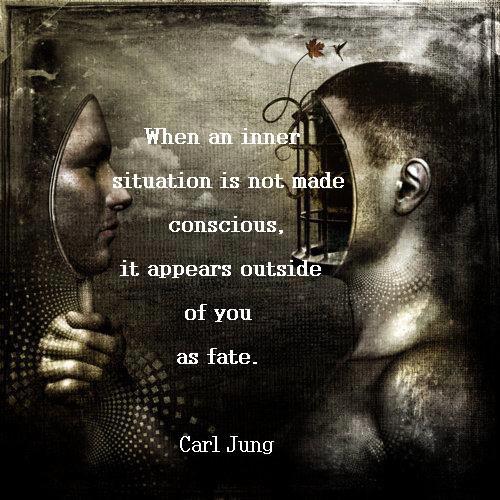
My shadow has hindered me, forced me to stick to the safe path, to protect myself, to find my tribe and stick closely to people who understand me, who agree with me, who I can relate to.  It has taught me to avoid situations that make me uncomfortable – like groups of macho men and male dominated spaces; mechanics workshops, some music stores.  It has taught me to moderate my behavior to suit the people I am talking to, so I don’t swing into full feminist critique in front of the bigoted dad of a friend. I can sniff out danger. My mother always taught me to avoid creepy men and I am not at all attracted to predators, but this shadow has made it difficult for me to trust men in general. Some of the most dangerous people I have known have been women and were once close friends.  I have learnt to cut these people out of my life. Some things are too scary to face and impossible to change.  I will keep delving into my shadow, walking through the dark, swimming through unconsciousness because I’m too scared not to. As Carl Jung said, “When an inner situation is not made conscious it appears outside of you as fate.” I don’t wast to take that risk. I don’t know what’s luring in the murky depths, but I’d certainly rather deal with it internally than allow it to manifest externally.

Nietzsche’s Archetypes : Camel, Lion, Child

http://www.osho.com/Main.cfm?Area=magazine&Sub1Menu=tarot&Sub2Menu=oshozentarot

Osho Zen Tarot: rebirth card.

In Zen you are coming from nowhere and you are going to nowhere. You are just now, here, neither coming nor going. Everything passes by you; your consciousness reflects it but it does not get identified. When a lion roars in front of a mirror, do you think the mirror roars? Or when the lion is gone and a child comes dancing, the mirror completely forgets about the lion and starts dancing with the child–do you think the mirror dances with the child? The mirror does nothing, it simply reflects. Your consciousness is only a mirror. Neither do you come, nor do you go. Things come and go. You become young, you become old; you are alive, you are dead. All these states are simply reflections in an eternal pool of consciousness.

Osho Osho Live Zen, Volume, 2 Chapter 16

In Zarathustra, Nietzsche describes the archetype of the camel as the typical state of unconsciousness pertaining to the general population. The camel does not strive, except for trying to fit in or keep up with the Joneses. The camel is comfortable with mediocrity and unsettled by the unusual. The camel follows the herd and does not question authority. Nietzsche was unapologetically scathing of camels. Carolyn Myss relates this archetype to what she refers to as the tribal level of consciousness.

The lion wants to do anything but follow the herd. It wants to fight and win. The lion seeks power and acknowledgment. The lion must always be right. Nietzsche’s lion fights the dragon. Myss relates the lion to the libel of the individual, the cult of which is prevalent in contemporary Western society.

The child symbolises awareness, rebirth, awakened consciousness. The child is innocent, not naive. The child forgives and let’s go because it is completely in the moment. It does not need to win, it simply is. The child is Nietzsche’s ubermensch and Myss’s level of the symbolic. From this level of consciousness we are able to step away from the drama of the tribe or individual and see the forest for the trees; we are able to recognise patterns across cultures, time and space, to rise above the herd and drop the fixations of ego. This is the level that archetypes work on, on which folk tales and mythology function; it is the level on which astrology, as a symbolic languages, resides.

The card in the image above also explores these archetypes, as follows:

Commentary:

This card depicts the evolution of consciousness as it is described by Friedrich Nietzsche in his book, Thus Spake Zarathustra. He speaks of the three levels of Camel, Lion and Child. The camel is sleepy, dull, self-satisfied. He lives in delusion, thinking he’s a mountain peak, but really he is so concerned with others’ opinions that he hardly has any energy of his own. Emerging from the camel is the lion. When we realize we’ve been missing life, we start saying no to the demands of others. We move out of the crowd, alone and proud, roaring our truth. But this is not the end. Finally the child emerges, neither acquiescent nor rebellious, but innocent and spontaneous and true to his own being. Whatever the space you’re in right now–sleepy and depressed, or roaring and rebellious–be aware that it will evolve into something new if you allow it. It is a time of growth and change.